

At a glance
Both natural and artificial flavors are widely used in everyday food products to enhance their taste and aroma. It’s generally known that artificial flavoring substances are linked to potential health risks. However, natural ones may also contain synthetic stabilizers or preservatives that don’t need to be disclosed on food labels, leaving consumers in the dark about what they’re actually eating.
Natural flavors vs. artificial flavors—what’s the difference, and does it really matter?
While natural and artificial flavors are added to enhance a food product’s taste and aroma, they differ significantly in how they’re sourced and in their potential health implications.
Discover why it’s vital to minimize the intake of artificial flavors and learn why natural flavoring substances don’t always equal healthy or nutritious.
What are artificial flavors?
Artificial flavors are food additives synthesized in laboratories rather than extracted from edible plants or animal sources and are used in a wide range of food products.
Food scientists can create various synthetic flavoring agents that closely mimic the chemical compounds responsible for specific tastes in whole foods, triggering the same sensory receptors as naturally occurring flavors.
In addition, these compounds allow the creation of non-natural flavor profiles, such as cotton candy, blue raspberry, or birthday cake, giving many highly processed foods their characteristic artificially flavored taste.
“The majority of artificial flavors are derived from basic industrial chemicals, including petroleum, plant processing waste, or fermentation processes,” explains Dr. Berg. “They’re often combined with other chemicals to reproduce, intensify, or standardize the desired taste of food products.”
Because they tend to be cheaper and more stable than natural flavors, artificial options are widely used in processed foods to create recognizable taste profiles.
Some of the most common artificial flavorings include strawberry, cherry, lemon, almond, butter, chocolate, apple, and grape flavor.
Products containing these additives are typically labeled “artificially flavored,” indicating that the flavor was developed using synthetic compounds rather than derived directly from whole foods.
Watch the video below to learn why many natural flavors may not be suitable for vegans.
What are natural flavors?
Natural flavors are flavoring compounds extracted from natural sources rather than synthesized in a laboratory.
Food manufacturers derive these flavors from a wide variety of natural products, including essential oils, fruit or vegetable juice, spices, herbs, meat, seafood, poultry, eggs, and dairy products.
These flavors are carefully extracted to capture the aromatic compounds that give natural foods their characteristic taste.
For example, vanilla beans are processed to create a natural vanilla flavor, while essential oils from citrus fruits can be used to produce natural orange or lemon flavors. Even edible yeast and fermentation products thereof can help create savory natural flavors.
Using natural flavors is often more costly, as extracting them from natural sources is labor-intensive, typically requires large quantities of raw ingredients, and may yield variable results depending on the season or source quality.
Potential concerns surrounding artificial flavors
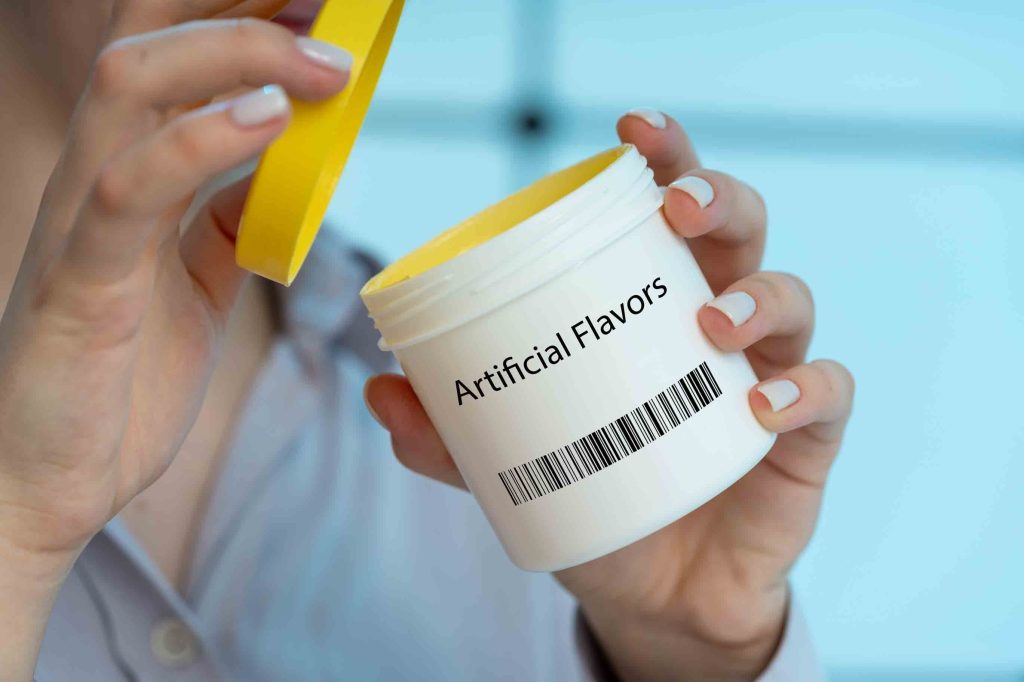
Although substantially more research has focused on artificial colorings and preservatives, evidence suggests that certain synthetic flavoring substances have been associated with adverse health outcomes.
While isolated chemicals that mimic the exact chemical structure of naturally occurring aromatic compounds don’t appear to be consistently linked to side effects, many artificial flavors are formulated by combining multiple synthetic chemicals.
Some of these complex flavor chemicals include solvents, emulsifiers, preservatives, and binders, which have limited long-term safety data when consumed regularly or in combination.
For example, research published in the Annals of the National Institute of Hygiene reported that diacetyl, an artificial butter flavoring commonly used in microwave popcorn, has been associated with inflammation and structural damage to the respiratory tract.
The authors summarize, “Diacetyl’s pneumotoxic action consists of inflammation, obstruction, and restriction in the distal respiratory tract.”
In addition, certain synthetic flavoring agents, including those used to create cherry or grape flavors, have been associated with an increased cancer risk, as reported in evidence published in Toxicology Research.
Other artificial flavor compounds have also been associated with alterations in gut microbiome composition and reduced microbial diversity, which can impact a wide range of physiological functions.
The potential health risks of artificial flavorings may be further compounded by their widespread use in ultra-processed foods.
Diets high in processed foods are linked to obesity, cardiovascular disease, type 2 diabetes, and other chronic health conditions, which may amplify concerns surrounding frequent exposure to synthetic additives.
This has been confirmed by a study published in the Archives of Disease in Childhood, which found that many synthetic additives in processed foods add no nutritional value but may have neurotoxic, cytotoxic, genotoxic, and carcinogenic effects.
Why “natural” doesn’t always mean minimally processed
Despite being derived from a plant or animal source, many natural flavorings undergo extensive industrial processing. They’re often combined with solvents, preservatives, or carriers to maintain stability, extend shelf life, and ensure consistent taste across batches.
As a result, the final product may differ substantially from the original whole-food source, both in composition and concentration, as well as potential health impacts.
Unfortunately, the Food and Drug Administration (FDA) doesn’t require full disclosure of the exact chemical makeup of seemingly natural flavors, leaving consumers in the dark about what they’re consuming.
For example, natural flavor mixtures often contain maltodextrin as a carrier or bulking agent. In some formulations, maltodextrin can make up as much as 80 percent of the total blend without being disclosed on the label.
However, maltodextrin is a highly processed carbohydrate with a high glycemic index. This means it rapidly raises blood sugar levels, thereby increasing the risk of weight gain, inflammation, and metabolic imbalances.
A study published in PLOS One further suggests that maltodextrin can disrupt beneficial gut microbes and may increase the risk of inflammatory bowel disease.
Similarly, hydrolyzed proteins and yeast extracts, though derived from natural sources, can release glutamates that act like monosodium glutamate (MSG) in the body.
These glutamate compounds are often used in savory flavor mixtures that can legally be labeled as natural flavor, despite being highly processed and potentially causing side effects similar to those of added MSG.
How to choose healthy alternatives
To minimize your exposure to potentially harmful flavoring substances, opt for organic products whenever possible. As stated in the Code of Federal Regulations, organic standards prohibit the use of synthetic solvents and artificial preservatives.
It’s also important to avoid ultra-processed foods and instead choose whole foods or products with short, easily recognizable ingredient lists. Check food labels carefully and select items with ingredients that are easy to identify and understand.
In addition, choosing plain and unflavored products helps limit potentially harmful additives and allows you to customize the taste to your preferences with herbs, spices, or natural sugar alternatives such as stevia or monkfruit.
Individuals with gut health concerns or sensitivities to natural or artificial flavoring agents can also contact brands directly to inquire about the specific composition of their flavor blends. If a company is unwilling or vague about providing this information, it’s safest to avoid the product.
Key takeaways
- Artificial flavors are synthetic compounds created in a lab, often combined with solvents, emulsifiers, and preservatives, that may be linked to various health issues.
- Natural flavors are derived from plant or animal sources but are often highly processed and can include hidden additives, meaning they aren’t automatically safer.
- Food labels don’t require full disclosure of flavor ingredients, leaving consumers uncertain about what’s potentially hiding in their foods.
- Minimizing ultra-processed foods and choosing organic or plain, whole-food products helps reduce exposure to potentially harmful flavoring agents.
FAQ
- 1. Which is better, natural flavors or artificial flavors?
- 2. What are natural flavors made from?
- 3. Do artificial flavors contain chemicals?
- 4. Why don’t companies list specific flavor ingredients?
- 5. Should you avoid products with added flavors?
Sources
- 1. Starek-Swiechowicz B, Starek A. Diacetyl exposure as a pneumotoxic factor: a review. Rocz Panstw Zakl Hig. 2014;65(2):87-92. https://pubmed.ncbi.nlm.nih.gov/25272573/
- 2. Smith RL, Cohen SM, Fukushima S, et al. The safety evaluation of food flavouring substances: the role of metabolic studies. Toxicol Res (Camb). 2018;7(4):618-646. doi:10.1039/c7tx00254h https://pmc.ncbi.nlm.nih.gov/articles/PMC6062396/
- 3. Warner JO. Artificial food additives: hazardous to long-term health? Arch Dis Child. 2024;109(11):882-885. doi:10.1136/archdischild-2023-326565 https://pubmed.ncbi.nlm.nih.gov/38423749/
- 4. Nickerson KP, McDonald C. Crohn’s disease-associated adherent-invasive Escherichia coli adhesion is enhanced by exposure to the ubiquitous dietary polysaccharide maltodextrin. PLoS One. 2012;7(12):e52132. doi:10.1371/journal.pone.0052132 https://pubmed.ncbi.nlm.nih.gov/23251695/
- 5. National Organic Program: nonagricultural (nonorganic) substances allowed as ingredients. 7 CFR §205.605. Electronic Code of Federal Regulations. Accessed March 13, 2026. https://www.ecfr.gov/current/title-7/subtitle-B/chapter-I/subchapter-M/part-205/subpart-G/subject-group-ECFR0ebc5d139b750cd/section-205.605
Related Articles
-
Food Intolerance Symptoms and How to Identify Patterns
 Digestive health
Food Intolerance Symptoms and How to Identify Patterns
At a glance Food intolerance symptoms can be difficult to connect to a particular food because they don’t always happen immediately after eating. Reactions may depend on portion size, food…07/30/2026 -
Sugar Alcohols: What They Are and How They Affect Digestion
 Food and Drink
Sugar Alcohols: What They Are and How They Affect Digestion
At a glance Sugar alcohols are low-calorie sweeteners commonly used in sugar-free foods, chewing gum, desserts, and other processed foods. Unlike regular sugar, many sugar alcohols are not fully absorbed…05/21/2026 -
Food Preservatives: Types, Safety, and Health Effects
 Nutrition
Food Preservatives: Types, Safety, and Health Effects
At a glance Food preservatives are common additives in packaged and processed food products that help extend shelf life and prevent spoilage. While some preservatives are derived from natural sources…04/03/2026 -
6 Natural Remedies for H. Pylori
 Health concerns
6 Natural Remedies for H. Pylori
At a glance Helicobacter pylori (H. pylori) is a common pathogen that infects the stomach and increases the risk of ulcers and other gastrointestinal symptoms. While conventional treatment relies on…03/19/2026 24.6k views -
How to Kill Parasites: 7 Natural Tips
 Health concerns
How to Kill Parasites: 7 Natural Tips
At a glance Parasitic infections occur when worms or protozoa colonize the body, often through exposure to contaminated pets, food, or water. These organisms can interfere with digestion and other…03/13/2026 15.1k views -
What Causes Pale Colored Stool?
 Health concerns
What Causes Pale Colored Stool?
At a glance Pale-colored stool can be linked to low bile flow, low-fat diets, alcohol use, infections, or underlying liver, gallbladder, or pancreatic issues. Supporting gallbladder function through a nutritious…02/26/2026 14.9k views -
3 Benefits of Oral Probiotics–And How To Use Them
 Digestive health
3 Benefits of Oral Probiotics–And How To Use Them
At a glance Oral probiotics are beneficial microbes that help maintain a balanced environment in the mouth, promoting strong teeth, healthy gums, and fresher breath. Supporting a diverse oral microbiome…02/20/2026 6.3k views -
What Is the Top Cause of Rosacea?
 Health concerns
What Is the Top Cause of Rosacea?
At a glance Rosacea is a chronic skin condition marked by facial redness and discomfort. The cause of rosacea extends beyond the skin, with growing research highlighting the connection between…02/20/2026 8.1k views -
Carnivore Diet: Weight Loss Tips, Benefits, and Risks
 Diet
DietCarnivore Diet: Weight Loss Tips, Benefits, and Risks
At a glance The carnivore diet relies solely on animal-based foods, eliminating all plants and carbohydrate sources. This shift can support weight regulation, stabilize blood sugar levels, and help lower…02/20/2026 5.3k views -
Can Iron Tablets Make You Feel Sick?
 Nutrition
Can Iron Tablets Make You Feel Sick?
At a glance Iron tablets can make you feel sick by irritating the intestines, altering the gut microbiome, and potentially damaging intestinal cells. While iron is essential in trace amounts,…02/13/2026 6.5k views


