

At a glance
Nutritional yeast supplements contain an inactive form of Saccharomyces cerevisiae that delivers B vitamins and trace minerals to help support energy production and overall metabolic functions. This deactivated yeast is available in flakes, powders, capsules, and tablets. Understanding how these forms differ can help you choose an option that aligns with your preferences and nutritional goals.
Nutritional yeast is an inactive single-cell fungus that offers naturally occurring vitamins, amino acids, and minerals that help support energy production, metabolic processes, and overall health.
Discover the potential benefits of nutritional yeast supplements and learn how to choose the right type to support your health and wellness goals.
What is nutritional yeast, and what does it do?
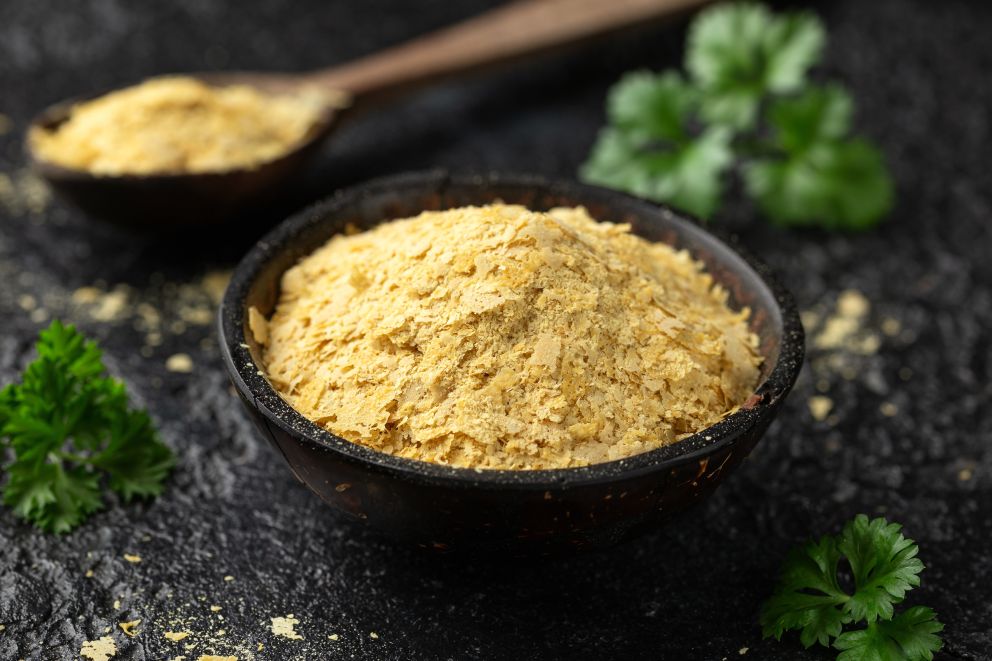
Nutritional yeast, often called “nooch,” is an inactive form of Saccharomyces cerevisiae, the same yeast species that is used in baking and brewing.
Saccharomyces cerevisiae is grown on molasses, then heated to stop its fermentation process, and finally processed into different forms, such as flakes, powders, capsules, or tablets.
Research published in Metabolites found that Saccharomyces cerevisiae is a highly available source of B vitamins, amino acids, and trace minerals that support energy production, metabolic functions, and overall health.
The authors summarize, “Yeast protein biomass also contains trace minerals and vitamins, including the B-group. Thus, yeast protein provides valuable nutrients.”
Nutritional yeast is a natural source of various nutrients, including:
- Vitamin B1
- Vitamin B2
- Vitamin B3
- Vitamin B5
- Vitamin B6
- Vitamin B9
- Iron
- Magnesium
- Zinc
- Selenium
- Potassium
Furthermore, nutritional yeast is considered a complete protein, as it’s a source of all nine essential amino acids that the body requires but can’t produce on its own.
As a result, nutritional yeast intake may support muscle mass maintenance and help the body produce enzymes needed for routine functions, such as nutrient breakdown and cellular activity.
What forms of nutritional yeast are used in supplements?
Nutritional yeast supplements are available in several formats, offering flexibility based on personal preference and intended use.
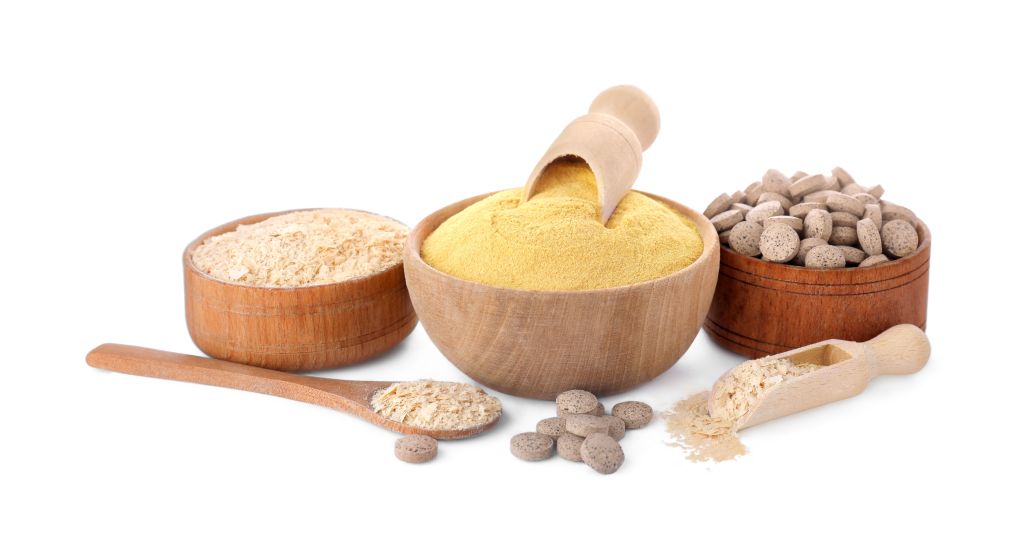
Here are four common forms of nutritional yeast supplements.
Nutritional yeast flakes
To produce nutritional yeast flakes, Saccharomyces cerevisiae is cultured, then carefully harvested, cleaned, and heated to deactivate the yeast cells and prevent further growth.
The yeast is then pressed into thin layers and gently broken into flakes, creating the familiar form that’s commonly used in cooking or packaged as a dietary supplement.
Many people choose to incorporate nutritional yeast in flake form because it adds a rich, umami flavor to dishes and can be easily sprinkled over foods or stirred into recipes without additional preparation.
Nutritional yeast powders
Powdered nutritional yeast is finely milled to create a smooth, uniform texture that mixes quickly into liquids.
Because powder forms are generally more concentrated than flakes, it typically requires less volume to achieve similar flavor intensity, with roughly one tablespoon of flakes equating to half a tablespoon of powder.
Powdered forms work well for recipes that require a creamy, even consistency, such as sauces, dips, and smoothies, and can be packaged in capsules or tablets.

Nutritional yeast capsules
Capsules contain powdered nutritional yeast enclosed in a hard-shell or soft-gel casing. The casing helps protect the contents from oxygen and moisture while making the capsule easier to swallow.
To maintain quality, store at a room temperature of 68 to 77°F (20 to 25°C) in a cool, dry place, as heat and humidity can damage the casing.
This form also eliminates the need for mixing or food preparation, making it especially suitable for those who prefer a convenient, neutral-tasting supplement.
Nutritional yeast tablets
Nutritional yeast tablets are created by compressing powdered nutritional yeast into a solid, compact form that delivers a fixed amount per serving.
Unlike capsules, tablets don’t require an outer shell. Although less sensitive to moisture than capsules, tablets should still be stored at room temperature to prevent heat or humidity from affecting their integrity.
Certain nutritional yeast products are formulated into tablets that can be either swallowed, chewed, or blended into foods or beverages, offering flexible options for individuals seeking convenient nutritional support.

How much nutritional yeast do supplements typically provide?
Formulations of nutritional yeast supplements can vary, but many products provide around 5 to 6 grams of yeast per serving.
The actual nutritional yeast content depends on the supplement’s form since flakes and powders are measured by weight or volume, while capsules and tablets divide the same total serving across multiple units.
Tablets are compact and provide a consistent, pre-measured amount of yeast, meaning it may take several tablets to achieve a full serving size as recommended by the manufacturer.

How to choose a nutritional yeast supplement
When selecting a nutritional yeast supplement, it’s important to consider how nutrients are sourced, processed, and verified.
If possible, select unfortified or minimally fortified products that contain only naturally occurring nutrients present in the yeast.
However, if the supplement contains added vitamins, choose products formulated with bioavailable forms rather than synthetic versions.
“Some yeast products contain cyanocobalamin, a synthetic form of vitamin B12 that the body may not use as efficiently,” explains Dr. Berg. “By contrast, supplements containing the active forms, such as methylcobalamin, are more readily absorbed and utilized.”
Quality markers also matter, and choosing non-genetically modified (GMO) and certified gluten-free nutritional yeast supplements can help support purity and safety.
This is especially relevant, as supplemental nutritional yeast is often grown on molasses or sugar beet–based products that may come from GMO sources.
In addition, choose brands that provide transparent labeling, clearly list nutrients and their amounts, disclose manufacturing standards, and undergo independent testing to ensure ingredient accuracy and overall quality.

Who should be cautious with nutritional yeast supplementation?
Although nutritional yeast supplements are generally well-tolerated when taken as directed, certain individuals may need to use caution before consumption.
This is crucial for those who are sensitive to Saccharomyces cerevisiae or naturally occurring glutamates, which are the compounds that contribute to savory flavors but may trigger headaches, digestive upset, or itchiness in sensitive individuals.
Yeast-containing products may also exacerbate symptoms in those with inflammatory bowel disease (IBD) or individuals prone to histamine reactions.
Therefore, it’s important to start with small amounts, monitor tolerance, and always consult a healthcare professional before incorporating nutritional yeast supplements into your routine.
Key takeaways
- Nutritional yeast, an inactive form of Saccharomyces cerevisiae, provides naturally occurring B-complex vitamins and key minerals.
- Supplemental nutritional yeast is available as flakes, powders, capsules, or tablets, each offering different levels of convenience.
- Some products are fortified with additional vitamins, including B12, with bioavailable forms like methylcobalamin being better absorbed than synthetic cyanocobalamin.
- Those sensitive to yeast or naturally occurring glutamate may experience digestive upset, and it’s best to consult a healthcare provider for individual guidance.
FAQ
- 1. What is the best form of nutritional yeast supplement?
- 2. Is nutritional yeast a complete source of B vitamins?
- 3. What is the difference between fortified and unfortified nutritional yeast?
- 4. How do nutritional yeast flakes differ from supplements?
- 5. Should nutritional yeast be taken with meals?


